A Response Part III: The Core Issue
Continuing to examine the claims made in an anti-LDS blog post, which I first linked to in Part I.
My thoughts and perspective on the idea of gatekeeping Christianity are explained at length in this blog in previous entries, so I won't repeat them here. The short version is this: I have never seen a person slam someone else's religious tradition for any kind of noble reason, and doing so goes directly against the claimed motive. I don't see a lot of value in attacking people's beliefs. It never ends well, and it reflects poorly on the attacker, whether they realize it or not. I will, however, enthusiastically criticize distortions and untruths (whether deliberate or accidental) about what I believe. Partly because it can be fun, but also because I feel that those who know the truth about something have a certain moral obligation to call out lies.
I'm examining a blog that uses, as its source, an anti-LDS website that claims to reveal all the ways the Church of Jesus Christ of Latter-Day Saints is supposedly un-Christian. What do you suppose the odds are of them presenting their claims accurately and completely?
Yeah, not good. But people believe it when they want to believe it.
Let's look at the next section in the blog I'm examining. If you want to see the original blog itself, I've linked it in Part 1.
Section 1D:
Our friend starts off with this:
"I shall again cite the above-linked website, then present my analysis:"
Ah, the website again. He quotes a passage discussing the LDS doctrine that Heavenly Father and Jesus Christ each have a physical body, and that the Holy Spirit is a spirit. Well, at least that is stated accurately, as it does seem to be quoting from Doctrine & Covenants. Specifically, D&C 130:22. It does not, however, quote the entire verse, nor does it include the next one, which provides a bit more information.
22 The Father has a body of flesh and bones as tangible as man’s; the Son also; but the Holy Ghost has not a body of flesh and bones, but is a personage of Spirit. Were it not so, the Holy Ghost could not dwell in us.
23 A man may receive the Holy Ghost, and it may descend upon him and not tarry with him.
So what does our friendly blog say about that?
"We already run into a contradiction of massive proportions here. God is supposed to be an omnipotent being, by His own admission, outside the limits of mortality. God's entire premise of supremacy of over all creation rests on this premise. If God is confined to a mortal shell of any sort, that makes the being the Mormons worship NOT the same God Christians worship. Jesus, as God's Son, adopted a mortal shell but had a spirit untainted by the seed of Adam. Mormons thus argue the same discredited heresy of Arianism, which rejected the concept Christ ever had a mortal form of any sort, given their take on the Garden of Eden. About the only thing they agree on Christians with is the Holy Spirit's form."
Did you catch the error there? He says, "If God is confined to a mortal shell of any sort..." Who said God is confined to a mortal shell? God is, of course, eternal. How does having a physical body change that? When Jesus Christ was born in Bethlehem, did He cease to be an immortal Being? When He ascended back to Heaven, did he leave that "mortal shell" behind? Of course not. Again, assumptions are being made here that are not supported.
Besides, the Old Testament references God's physical form. Remember that time Moses went up Mount Sinai and asked to see God in His glory? God wouldn't allow him to see His face (He has a face. How about that...), but Moses could see other parts of Him.
Exodus 33:18-23
18 And he said, I beseech thee, shew me thy glory.
19 And he said, I will make all my goodness pass before thee, and I will proclaim the name of the Lord before thee; and will be gracious to whom I will be gracious, and will shew mercy on whom I will shew mercy.
20 And he said, Thou canst not see my face: for there shall no man see me, and live.
21 And the Lord said, Behold, there is a place by me, and thou shalt stand upon a rock:
22 And it shall come to pass, while my glory passeth by, that I will put thee in a clift of the rock, and will cover thee with my hand awhile I pass by:
23 And I will take away mine hand, and thou shalt see my back parts: but my face shall not be seen.
I'm sure some would say this is a metaphor, but God is telling Moses that no man can see His face and live. The only reason to assume that's some kind of metaphor is if you're already trying to read something into the text. Namely, that God has no body. The simplest reading of this passage says otherwise. If God says He has a face, then He has a face.
In this same paragraph, I quoted GethN7, then weirdly says that "Mormons thus argue the same discredited heresy of Arianism, which rejected the concept Christ ever had a mortal form of any sort..."
Hold on a second... if Latter-Day Saints believe that Jesus Christ DOES have a physical body, then how is it that we're arguing the same stuff as Arianism? He says right there that Arianism says that Jesus Christ NEVER had a mortal form. That isn't the same, is it?
The website he's quoting from goes into some discussion about Brigham Young discussing the existence of other gods and worlds. The quoted passage from the website then goes on to say that Latter-Day Saints have a God that is not a different type of being than man... all because we understand that God has a physical body.
Again, all of this criticism here hinges on the notion that somehow God having a physical form must make Him exactly like us... mortal and human. That's an assumption without any support. Why couldn't God be eternal and omnipotent and still have a body? I mean, have you ever seen the ceiling of the Sistene Chapel? I don't see anybody complaining about that. Michelangelo painted God. Does that mean that he must not have been a Christian because he depicted God with a body?
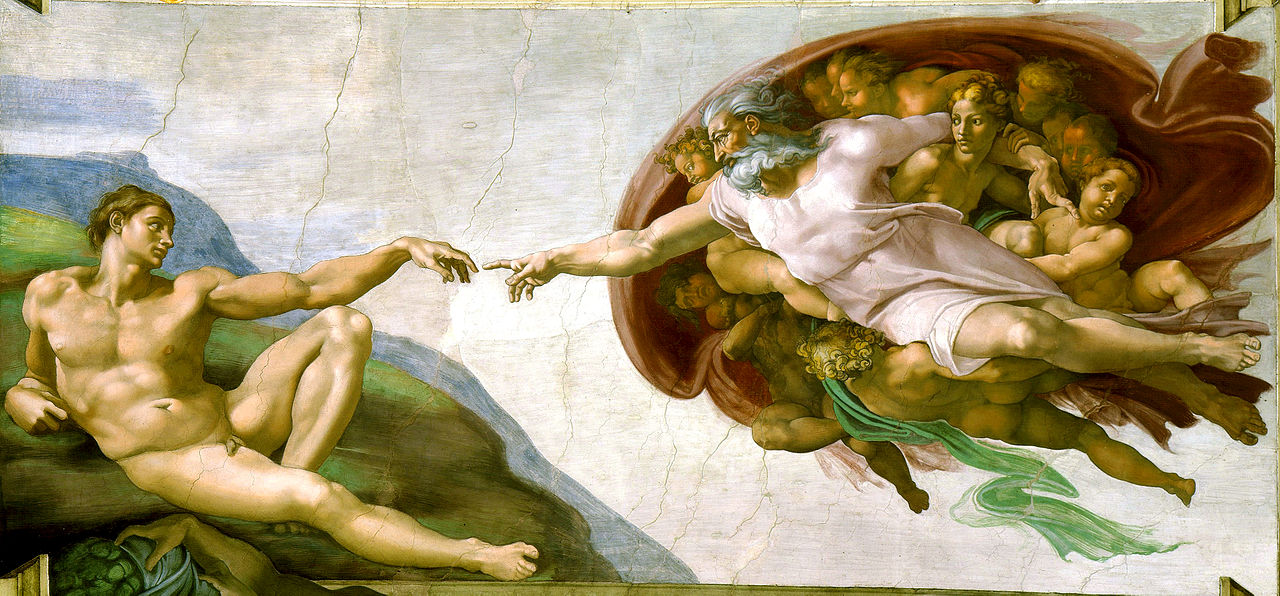
Now let's be clear: I'm not saying that Michelangelo's painting is evidence of God having a body, and I'm not making any kind of claims about what Michelangelo believed on that point. All I'm saying is that the notion of God having a physical form is not so outlandish as is being suggested by GethN7 and his source. But, I guess everything Latter-Day Saints believe has to be presented in the most exaggerated and shocking way possible to convince the reader that Latter-Day Saints can't be Christians.
Which is, of course, absurd.
He goes on to say, commenting on the passage about Brigham Young:
"Again, Mormons are at direct cross-purposes with the Bible. The very first line of the Bible said God created the heavens and the earth and before that the corporeal universe as we know it did not exist until He said so. This is rendered an absurdity under Mormon doctrine. Further, God made clear multiple times humanity was NEVER at any level equal or approximate to Him. If God is as they say, he is NOT an omnipotent being without mortal limits, and thus I contend they do not worship the same God as Christians."
What's absurd about God having a body AND being the Creator of the Universe? He keeps accusing Latter-Day Saints of believing in a version of God that is mortal and limited, and yet seems to limit God to somehow not being able to have a body. I just don't see what the problem is with that, but I guess we really have to play that up, don't we?
As for man being equal to God... No, God is God. If we were His equals somehow, why would we need Him, much less the Atonement? He is, and always will be, our God, our Heavenly Father. We won't equal Him. The only people claiming we believe otherwise are people like the ones running that website. (There's a lot more to it than just this, but I'm limiting my responses to the specific points being offered in GethN7's blog.)
Now, in the next section, we get into the nitty-gritty. This is the good stuff. The stuff every LDS vs. Protestant argument I've ever seen or been involved in boils down to. He quotes a passage from the anti-LDS website talking about how Latter-Day Saints aren't Trinitarian, and that we believe God the Father, Jesus Christ, and the Holy Spirit are three distinct Beings who together are known as the Godhead.
Well, at least in that statement, they are correct. And this, I'm told, is the core reason why Trinitarian Christian (Or Nicene Christians, as I like to call them sometimes) traditions exclude LDS. We apparently don't get to call ourselves Christians because we do not believe in the doctrine of the Trinity.
He says:
"We've already established their own doctrine makes a hash of the very content of the Bible, and this part is even more absurd. The Father, Son, and Holy Spirit are a triune entity in Christian thought, but Mormons declare them all separate beings with a shared vision, which is logically absurd on its face. The Holy Spirit is supposed to be what leads men to God, the Son made clear he only spoke in the name of his Father, and the Father (God) is why the other two exist. They are three separate entities yes, but of the same being incarnate in three forms that share the same inherent essence according to the scriptures of which I am aware. Again, Mormons are recycling Arianism's discredited canards despite the logical errors they present."
It isn't clear to me how this is a recycling of Arianism, but I guess we're left to take GethN7's word for it. (Not that it makes any difference anyway.)
He says here that the idea that the Father, the Son, and the Holy Spirit are separate is "logically absurd on its face." GethN7 cites logic a lot in his blog, but doesn't seem to ever get around to explaining why, exactly, this idea is illogical. Quite frankly, I personally find the idea of the Trinity doctrine to be illogical, and that's coming from someone who was a Catholic for the first 24 years of my life.
I'll give 3 examples as to why I regard the Trinity doctrine to be illogical. I don't mean to attack, but this needs to be said in order to illustrate what I mean. Let's start by looking at the Baptism of Jesus as depicted in Luke:
Luke 3:21,22
21 Now when all the people were baptized, it came to pass, that Jesus also being baptized, and praying, the heaven was opened,
22 And the Holy Ghost descended in a bodily shape like a dove upon him, and a voice came from heaven, which said, Thou art my beloved Son; in thee I am well pleased.
The Latter-Day Saints' take on this is that Jesus, having been baptized, has pleased Heavenly Father. The Holy Spirit appeared and descended upon Him, and Heavenly Father spoke to Jesus to express His approval of Jesus.
The Nicene Christian take on this is that the triune God, as Jesus, was baptized. Then, for some reason felt the need to manifest as a dove to descend in the aspect of the Holy Spirit, and then spoke to Himself using a voice from the sky (or heaven) to tell Himself that He was well pleased with Himself.
Hm. Maybe that's a bad example. Let's take a look at Jesus' experience in the Garden of Gethsemane shortly before He was arrested by the Romans:
Matthew 26:39
39 And he went a little further, and fell on his face, and prayed, saying, O my Father, if it be possible, let this cup pass from me: nevertheless not as I will, but as thou wilt.
And verse 42:
42 He went away again the second time, and prayed, saying, O my Father, if this cup may not pass away from me, except I drink it, thy will be done.
The Latter-Day Saints' take on this is that Jesus was preparing Himself for what He knew was coming. His suffering in the Garden and subsequent sacrifice on the cross were not something He was looking forward to. (Understandably!) That's the cup that He was asking to pass from Him if possible. But He also acknowledges that, if it isn't possible for the cup to pass from Him (which it clearly was not), then it would be done not according to Jesus' will, but that of God the Father.
The Nicene Christian take on this seems to be that Jesus was praying to Himself and wrestling with whether or not to go through with the crucifixion. But if it had to be, then it would be according to His will, not His.
Still not seeing how the Trinitarian version is more logical than the Latter-Day Saints' understanding of it. Let's look at one more. We go now to the crucifixion, and that awful moment where Jesus cried out to God.
Matthew 27:46
46 And about the ninth hour Jesus cried with a loud voice, saying, Eli, Eli, lama sabachthani? that is to say, My God, my God, why hast thou forsaken me?
We understand this, and it makes perfect sense. It is the moment where Jesus truly felt alone and abandoned, to the depth of the kind of suffering His sacrifice was sparing us from. Because He did this for us, we need not ever feel alone and forsaken by our Heavenly Father. Jesus experienced it so that we don't have to if we only choose to follow Him.
The Nicene Christians seem to think that Jesus cried out to Himself to ask why He abandoned Himself.
I know the way I wrote that may come across like I'm trying to be funny, but I'm really not. This is just how it sounds to me. If it seems ridiculous, well, that isn't my fault; that's the way the text reads. The doctrine of the Trinity insists that Jesus, Heavenly Father, and the Holy Spirit are all one in the same, so we really do have three examples here where a trinitarian believer MUST conclude that God talks to Himself, even when there is nobody else around. If the trinitarian view is indeed the correct one, then the triune god openly expressed being pleased with himself, struggled with indecision, and ultimately cries out in a way that simply doesn't make any sense at all.
But it's the Latter-Day Saints that have an illogical view? Really? I've just presented three of the most well-known moments in the New Testament, and the simplest, most direct understanding of these scriptures is that Jesus, Heavenly Father, and the Holy Spirit are three separate beings. They are. It's that simple. It's all there in the Bible. A child could understand it.
See, the problem here is that the Nicene/Trinitarian traditions really have this as their core, their foundational belief. Ultimately, this is the most critical element of understanding the nature of Jesus Christ. None of the other stuff we've discussed even matters in the face of that issue. It doesn't matter whether the Bible is perfect, whether we lived before we came to this world, or whether God can sit in a chair. I'm not prepared to say that Nicene Christians aren't really Christians because they have this wrong, but I'm also not going to come at this as if it's my job to prove to them that Latter-Day Saints are Christians. As far as I'm concerned, if anybody has the burden of proof, it is them. It isn't up to me to show why Jesus and God the Father are very obviously two separate beings. It's on them to explain to me how a simple and reasonable interpretation of the Bible is somehow so far off the mark and incorrect that it would call into question the veracity of the statement "I'm a Christian."
Until someone can show me how these events logically support the notion of the Trinity, then I'm not going to take any accusations of heresy regarding this issue seriously when leveled against me or my Church.
Comments
Post a Comment